What Is Quotex Trading and How Does It Work?
Overview of Quotex as a Digital Options Platform
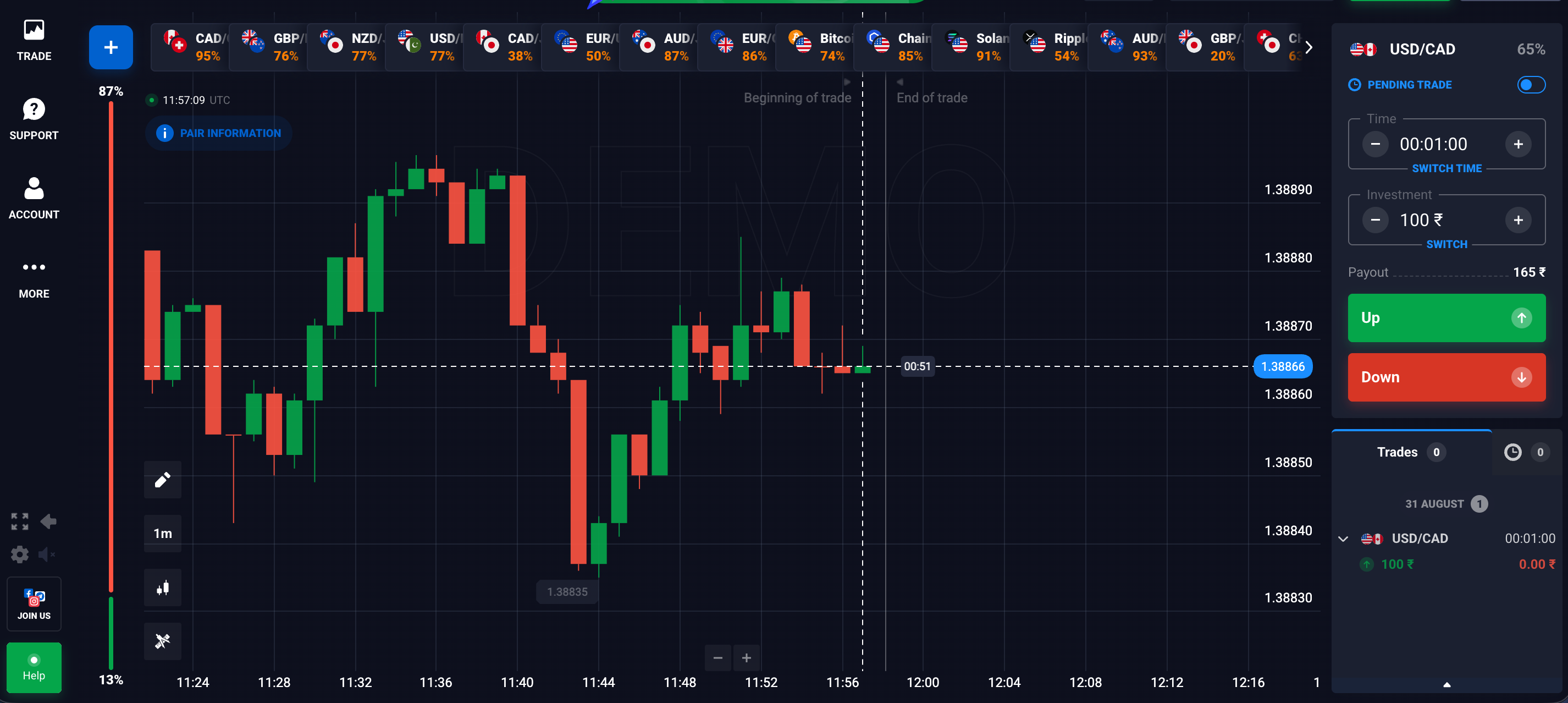
Understanding what is quotex trading requires examining its core architecture as a web-based digital options broker. Quotex provides access to short-term derivative contracts based on the price movements of underlying assets. Instead of taking direct ownership of currency pairs, commodities, or equities, traders speculate on whether an asset's market price will trade above or below a specified strike price at a designated expiration time.
The platform relies on a simplified user interface connected to price feed aggregators. Order execution happens directly through browser or mobile environments, routing user inputs instantly to finalize contract terms. Because the settlement occurs entirely on the platform, execution efficiency and feed transparency serve as primary operational parameters for traders evaluating liquidity and price fidelity.
Is Quotex Considered a Binary Options Broker?
Yes, Quotex operates fundamentally as a binary options platform, often categorized under the term "fixed-time trades" (FTT). The mechanism follows a binary outcome: the contract settles either entirely "in-the-money" (yielding a predetermined profit percentage) or "out-of-the-money" (resulting in the loss of the allocated stake).
Unlike traditional vanilla options traded on standard exchanges, digital options on Quotex do not feature dynamic pricing models governed by option Greeks (Delta, Gamma, Theta, Vega). The distance by which the asset moves beyond the strike price is irrelevant to the overall payout. A price difference of a single micro-pip at expiration yields the exact same payout as a major trend extension.
Contract Mechanics: Expiry Times and Payout Structure
How Fixed Time Expirations Affect Trade Outcomes
Contract duration is a critical variable on the platform. Expiration windows range from ultra-short timeframes (such as 5 seconds or 1 minute) to longer-term durations spanning hours or days. When entering a position, the trader locks in the current spot rate as the strike price, and the platform initiates an automated countdown timer.
Short-term expirations increase exposure to market noise and high-frequency order flow fluctuations. For institutional or quantitative traders, sub-minute timeframes represent high variance environments where technical patterns can break down due to micro-structure shifts. Longer expiration horizons allow macro trends and structural support or resistance levels to play a more reliable role in technical setups.
Understanding Yield Percentages and Price Movement Requirements
Payout structures on Quotex are dynamic, expressing potential return as a percentage of the capital committed to an individual trade. Yield percentages vary based on several market variables:
- Asset Liquidity: High-volume major currency pairs typically offer higher yield rates than illiquid assets.
- Market Volatility: Yields adjust during peak trading hours (such as the London/New York session overlap).
- Account Type and Timeframe: Dynamic payout algorithms alter yields based on selected contract lengths.
Because the payout ratio is typically less than 100% (often fluctuating between 70% and 90%), digital options feature a negative expected value (EV) on a raw 50/50 win-rate basis. Traders must maintain a win rate higher than the break-even mathematical threshold to remain profitable over a statistically significant sample size.
Available Asset Classes and Charting Capabilities
What Assets Can You Trade on the Quotex Platform?
Quotex grants access to several global financial markets through synthetic contract settlement. The primary asset classes include:
- Foreign Exchange (Forex): Major, minor, and exotic currency pairs.
- Cryptocurrencies: High-volatility digital assets settlement available 24/7.
- Commodities: Spot metals (Gold, Silver) and energy products (Crude Oil).
- Stock Indices: Speculative access to global benchmark equity indexes.
- OTC (Over-The-Counter) Pairs: Proprietary off-market feeds available during weekend hours when primary interbank markets are closed.
Integrated Technical Analysis Tools and Chart Types
The platform features native charting engines capable of displaying price action through Candlestick, Area, Bar, and Heikin-Ashi visual models. Advanced analytical overlays include standard technical indicators such as Moving Averages, Relative Strength Index (RSI), Bollinger Bands, and Stochastic Oscillators.
While native drawing tools allow traders to map horizontal levels, trendlines, and Fibonacci retracements, professional traders often cross-reference Quotex pricing feeds with external charting platforms (such as TradingView or MetaTrader) to perform deep structural analysis and confirm tick data accuracy.
Execution Velocity and Technical Analysis Integration
Order Execution Speed for Short-Term Strategies
Execution velocity is critical when trading fixed-time options. In fast-moving markets, network latency or server-side queueing can lead to slippage—causing the entry strike price to differ from the visual signal on the chart. Quotex utilizes lightweight web protocols to minimize execution delays, allowing rapid order confirmation.
For traders executing scalping systems or momentum-breakout models on lower timeframes, low-latency execution ensures that entries align precisely with candlestick open times or volatility spikes.
Customizing Indicators and Drawing Tools for Advanced Trading
To construct an edge, advanced operators calibrate default indicator parameters to filter out market noise. For instance, modifying oscillator smoothing periods or combining multi-timeframe moving averages helps align fixed-time contract expirations with broader trend direction. Combining visual support/resistance zones with volume or momentum confirmation reduces false breakout entries.
Essential Risk Control Protocols for Experienced Traders
What Are the Main Risks Associated with Quotex Trading?
Trading digital options carries distinct structural and psychological risks that differ from traditional spot or futures trading:
- Asymmetric Risk/Reward: Max loss is capped at 100% of stake, while max gain is capped below 100%, requiring a win rate well above 50-55% depending on payout rates.
- Lack of Early Exit Flexibility: While early contract cancellation may be supported under specific conditions, payouts for early closures are significantly reduced, limiting trade management options once executed.
- Emotional Over-Trading: Rapid expiration cycles encourage high trade frequency, increasing vulnerability to emotional decision-making and revenge trading.
Advanced Position Sizing and Capital Preservation Rules
To mitigate the mathematical drag of fixed payout structures, sophisticated traders implement strict capital preservation frameworks:
- Fixed-Fractional Position Sizing: Limit risk per contract to 1% to 2% of total account equity, protecting the account against extended losing streaks.
- Avoid Martingale Models: Avoid progressive betting models that double position sizes following losses. Martingale strategies exponentially increase the risk of complete capital depletion during tail-risk events.
- Daily Drawdown Limits: Enforce hard stop rules (e.g., terminating execution after a 5% daily drawdown) to preserve capital and maintain psychological neutrality.



Comments
No comments yet.
Leave a comment
Comments are moderated and will appear after approval.