
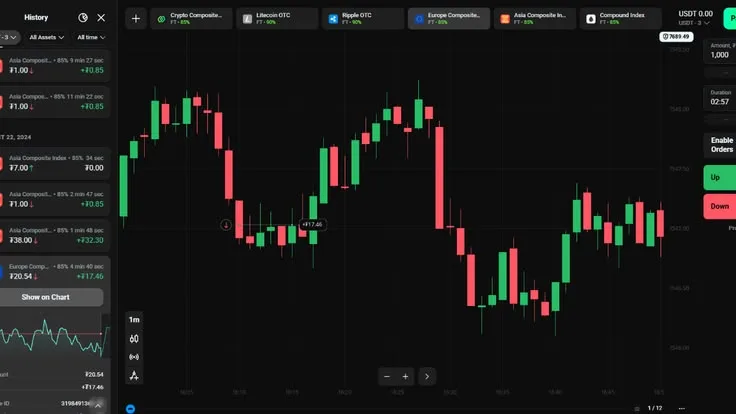
Intermediate traders often transition to short-duration digital contracts expecting fast results, only to discover that raw technical signals behave differently when bounded by a strict clock. Developing disciplined Quotex trading strategies requires more than hitting a direction call whenever two lines cross. Because fixed-time payouts are binary, your entry timing, structural context, and expiry selection carry just as much weight as market direction.
To construct reliable trading systems, you must filter out lower-timeframe noise and resist the temptation to chase every price tick. True consistency comes from pairing price action context with objective indicator confirmation, backed by rigorous position sizing.
Filtering Moving Average Crossovers with Oscillator Confirmation
Moving average crossovers are among the first setups technical traders learn, but in fixed-time trading, relying on them in isolation is dangerous. A basic crossover between a short-term Exponential Moving Average (such as the 9 EMA) and a medium-term curve (such as the 21 EMA) frequently whipsaws during low-volume or range-bound market conditions.
To increase the probability of a setup, combine momentum oscillators with your chart tools (for a deeper breakdown of settings, see our Quotex indicators guide) to act as a permission filter before placing a trade:
- The Trend Entry Condition: Wait for the 9 EMA to cross cleanly above the 21 EMA while price trades above a longer-term baseline, such as a 200-period Simple Moving Average (SMA).
- The Oscillator Filter: Check the Relative Strength Index (RSI set to 14 periods) or the Stochastic Oscillator (5,3,3). For a bullish entry, the RSI should be crossing above 50 from below, confirming accelerating momentum, rather than sitting already deep in overbought territory (above 70).
- The Trap to Avoid: If the moving averages cross while price is squeezed inside a narrow range or flat Bollinger Bands, ignore the signal entirely. Crossovers inside consolidation ranges reflect market indecision, not emerging momentum.
Trading Market Structure: Real Breakouts vs. False Liquidity Swings
Short-term charts on Quotex are frequently punctuated by sharp wicks that breach support or resistance levels only to snap back immediately. Traders who blindly buy every touch of a key level usually find themselves caught in these false breakouts, often referred to as liquidity sweeps.
Instead of entering trades the moment price touches a horizontal level, wait for structural confirmation:
Look at how price approaches the key boundary. If price consolidates just beneath a resistance level, forming a series of higher lows, buying pressure is absorbing supply. This compression pattern indicates that a genuine breakout is far more likely than a sudden drop.
Conversely, if price surges into a resistance level on a single, unusually large vertical candle, exercise caution. These explosive moves often represent an exhaustion spike rather than sustainable buying interest. In these scenarios, waiting for a clear candle body close outside the range—followed by a brief retest of the broken level as new support—provides a much higher-probability entry than jumping in on impulse.
Matching Expiry Durations to Candle Timeframes
An accurate directional call will still lose money if the trade duration is misaligned with chart volatility. A common blunder on Quotex is trading 1-minute expiration contracts while analyzing 1-minute or 5-minute charts without allowing space for normal price oscillations.
A practical baseline for fixed-time strategies is the 2x to 3x Candle Rule:
- If you perform your technical analysis on a 1-minute chart, set your trade duration between 2 and 3 minutes.
- If you analyze setups on a 5-minute chart, set your trade duration between 10 and 15 minutes.
This timing buffer gives the market room to absorb minor pullbacks or micro-retests without prematurely stopping out your position before the larger move unfolds. Understanding timing nuances is essential to mastering short-term trade lifecycle mechanics.
Capital Preservation and Risk Management
No technical strategy, no matter how refined, eliminates directional risk. Financial trading involves substantial risk of loss and can result in the complete loss of your deposited funds. The content provided here is strictly for educational purposes and should never be treated as direct financial advice or trading signals.
Long-term survival on short-duration platforms depends on managing your downside risk with total discipline, much like building a structured baseline when you learn how to create a trading plan:
- Fixed Fractional Sizing: Risk no more than 1% to 2% of your total account balance on any single trade. If you hold a $1,000 account balance, individual trade stakes should remain at $10 to $20 regardless of how confident a specific setup looks.
- Avoid Recovery Traps: Martingale techniques—doubling trade amounts after a loss to recover capital—are statistically proven to deplete accounts during unexpected streak losses. Treat every trade as an independent event.
- Daily Loss Ceilings: Establish a strict session stop-loss limit (for example, stopping after 3 consecutive losing trades or a 5% drawdown). Step away from the platform immediately when that limit is reached to protect your mental state and trading capital.
Frequently Asked Questions
What is the most reliable chart timeframe for Quotex strategies?
The 5-minute chart generally offers a better balance between signal frequency and reduced market noise compared to 1-minute charts. Analyzing market structure on a 5-minute timeframe while setting contract expiries to 10 or 15 minutes helps eliminate the erratic price spikes that often ruin short-duration trades.
Why do traditional indicator strategies fail on fixed-time trades?
Standard technical indicators were designed to forecast direction rather than exact timing. On platforms like Quotex, an accurate directional prediction still results in a loss if the price move occurs seconds after your contract expires. Indicators must be combined with structural price action and appropriate expiry multipliers to work reliably.
Should I use a Martingale strategy on Quotex to recover losses?
No, applying a Martingale strategy is extremely high-risk and routinely leads to total account loss. Because binary payout rates are always below 100%, doubling your stake after losses creates an asymmetric risk curve where you risk massive capital amounts simply to recover a small initial stake. Flat staking protects your drawdown capacity.



Comments
No comments yet.
Leave a comment
Comments are moderated and will appear after approval.