
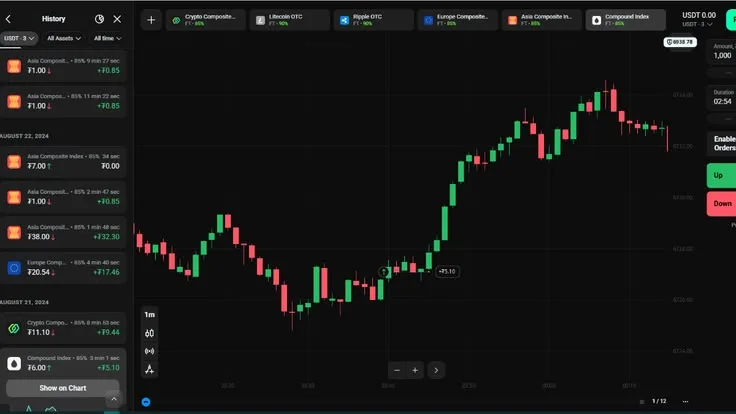
Most newcomers entering short-term market environments arrive with expectations shaped by online highlights, only to quickly realize that financial markets do not reward guesswork. When exploring resources like a dedicated Quotex trading platform blog guide, the combination of real-time candlestick charts, fast-moving order options, and customizable timeframes can feel both empowering and chaotic. Developing a sustainable approach requires stepping back from the excitement and focusing on structured skill acquisition.
The goal for any beginner isn't to start making instant predictions, but to build a repeatable method for analyzing price action, managing risk, and keeping emotions in check. If you are brand new to order types, start with our step-by-step beginner's guide to understand basic mechanics before executing live entries. By treating technical tools as objective observations rather than magic formulas, you place yourself in a far better position to navigate live market conditions responsibly.
Finding Verified Learning Resources Within the Platform Interface
Before placing a single practice order, your first task is to familiarize yourself with the platform's analytical environment. High-quality learning starts by exploring built-in charting capabilities, indicator drawers, and official help documentation rather than relying on third-party noise.
Avoid searching social media for short-term "guaranteed signals" or automated trading bots. These shortcuts almost always lead to poor risk habits and account losses. Instead, consult reliable educational updates on the Quotex trading platform blog and examine the official platform manual to understand how order execution, asset schedules, and payout structures function under varying market conditions. For foundational operational concepts, consult our overview on how Quotex works.
- Asset Schedules and Volatility: Learn when specific currency pairs, commodities, or indices experience peak volume, as low-liquidity periods often produce unpredictable price spikes.
- Chart Type Options: Practice switching between tick charts, area displays, and standard Japanese candlesticks to understand how price data is aggregated across timeframes.
- Historical Data Review: Use the chart scrolling features to look back at previous market sessions and observe how prices reacted to major news announcements or key support levels.
Structuring Practical Workouts Around the Free Demo Account
A practice balance is one of the most useful educational tools available, yet it is frequently misused. Beginners often treat virtual funds like video game points—placing oversized trades simply because the money isn't real. This habit creates a dangerous false sense of security that leads to immediate capital loss when transitioning to live funds. Read our full Quotex demo account guide for structured practice ideas.
To turn virtual trading into a meaningful learning routine, reset your demo balance to match the exact amount you intend to deposit in real capital. If you plan to start with $100 in real funds, practicing with a $10,000 balance teaches you position sizes that are completely detached from your personal financial reality. Intermediate traders looking to organize structured practice sessions can also refer to our guide on demo trading session setup.
Establish a systematic 30-day practice protocol before executing live trades:
- Maintain a Trade Log: Document the entry asset, time of day, expiration length, technical indicators used, and the underlying reason for every trade.
- Set Daily Limits: Cap your practice trades to three or four per day to prevent overtrading and maintain analytical focus.
- Review Results Objectively: Analyze your losing trades with the same curiosity as your winning trades. Identify whether a loss resulted from poor timing, unexpected news, or breaking your own rules.
Applying Core Technical Indicators Without Clutter
It is tempting to stack a dozen technical indicators onto a single chart in search of absolute certainty. In practice, this leads to "analysis paralysis," where conflicting signals prevent clear decision-making. Beginners should master two or three foundational tools that offer complementary insights into trend, momentum, and volatility.
Moving Averages (Trend Identification)
A Simple Moving Average (SMA) or Exponential Moving Average (EMA) smooths out price fluctuations to show the underlying direction of the market. A common approach is viewing a medium-term moving average (like the 20-period EMA). When price trades consistently above the line, the market is displaying upward momentum; when below, downward momentum dominates.
Relative Strength Index (RSI)
The RSI measures the speed and change of price movements on a scale from 0 to 100. Readings above 70 generally indicate overbought conditions where price may pull back, while readings below 30 suggest oversold conditions. Rather than trading these extremes blindly, look for price confirmation, such as a candlestick reversal pattern, before making an entry decision.
Bollinger Bands (Volatility Expansion and Contraction)
Bollinger Bands consist of a center moving average flanked by two standard deviation lines. When the bands contract tightly together, it signals low volatility—a phase often followed by an aggressive price breakout. When the bands expand wide apart, it indicates high volatility where price is reaching statistical extremes.
Capital Preservation: Position Sizing and Hard Risk Limits
In digital options trading, every trade carries an asymmetric risk profile: a winning trade yields a fixed percentage payout, while a losing trade results in a 100% loss of the allocated stake. Because of this structure, poor capital allocation will destroy an account far faster than a flawed technical strategy.
A standard rule of capital preservation is never allocating more than 1% to 2% of your total account balance to a single trade. If your account holds $200, your maximum risk per trade should be $2 to $4. This position sizing allows you to survive extended losing streaks without draining your balance or inducing panic.
Trading Risk Statement: Trading financial instruments carries a high level of risk and can result in the complete loss of your deposited funds. The educational concepts discussed in this guide are provided strictly for training purposes and do not constitute financial advice, signals, or guaranteed outcomes. Never trade with money you cannot afford to lose.
Avoiding Psychological Traps in Short-Term Options
The fast-paced nature of short-term expiry cycles (such as 1-minute or 5-minute trades) creates intense psychological pressure. The human brain naturally seeks to recover losses quickly, which often triggers emotional traps that bypass rational strategy.
The most destructive mistake is revenge trading—immediately placing a larger trade right after a loss to "get even" with the market. Another dangerous approach is the Martingale strategy, which involves doubling your trade size after every loss. While this may sound mathematically tempting, a short sequence of consecutive losses will rapidly wipe out your entire balance.
To maintain mental clarity, define clear operational boundaries before opening your chart session. Decide on a maximum daily loss threshold (for example, stopping after three consecutive losses or a 5% total account drawdown). Once that threshold is reached, close the platform and step away for the day. Consistency comes from protecting your mental energy and preserving capital for high-probability setups on another day.
Frequently Asked Questions
How should beginners use the Quotex demo account to prepare for live trading?
Beginners should configure their demo account balance to reflect the exact dollar amount they plan to deposit in real funds. Treat every virtual trade with strict discipline by documenting entry triggers, applying a maximum 1% to 2% position size per trade, and keeping a trade journal to identify bad technical or emotional habits before live capital is involved.
What is the biggest risk when trading short-term digital options?
The primary risk is the fixed-loss payout structure, where a single losing trade results in losing 100% of the invested stake. Because wins return less than 100%, traders need strict position sizing and a win rate supported by objective analysis. Without disciplined risk controls and sound mental health habits, account balances can erode very quickly.
Why is the Martingale strategy dangerous for new traders?
The Martingale strategy requires doubling your investment after every losing trade in an attempt to recover past losses with a single win. Because market trends can produce extended sequences of losses, this approach exponentially increases risk and frequently leads to total account loss in a very short period.
How many technical indicators should a beginner use at once?
Beginners should limit themselves to two or three complementary indicators, such as combining a moving average for trend direction with an RSI for momentum confirmation. Using too many indicators simultaneously causes chart clutter and conflicting signals, which leads to indecision and poor execution. For more quick answers, see our Quotex trading FAQ guide.



Comments
No comments yet.
Leave a comment
Comments are moderated and will appear after approval.